When comparing hybrid vs petrol cars, the focus is generally on the fuel economy or running costs. But what about the driving experience when you get behind the wheel?
From quieter take-offs and smoother stop-start traffic to the way the car responds when you accelerate, driving a hybrid can feel quite different to a traditional petrol vehicle.
We’ll explain what the difference between hybrid and petrol cars is, how Toyota Hybrid Electric vehicles work and what it’s really like to drive a hybrid on your day-to-day. If you’re considering making the switch to a hybrid vehicle, understanding how it feels behind the wheel can help you decide whether it’s the right fit for you and your lifestyle.
Hybrid vs petrol cars explained in 30 seconds
The biggest difference between hybrid cars and petrol cars is how they power the vehicle while you’re driving. A standard Toyota Hybrid Electric Vehicle (HEV) combines a petrol engine and an electric motor, automatically switching between them or operating together depending on driving conditions [1]. In comparison, a traditional petrol car relies only on its petrol engine.
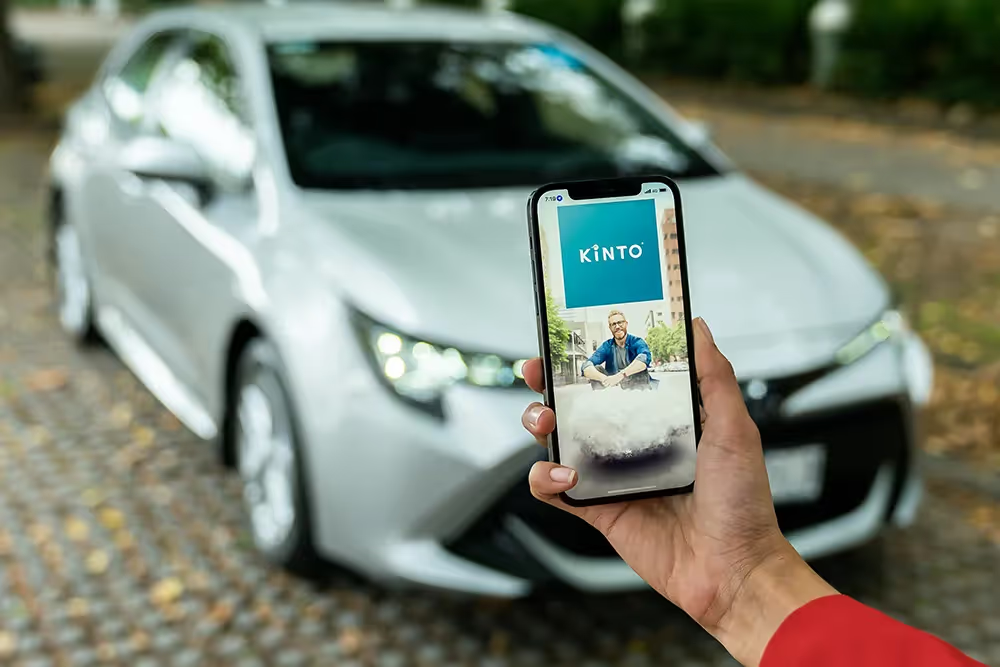
Want to experience a Toyota Hybrid Electric vehicle for yourself? Explore KINTO hybrid car pricing and browse our fleet to find the right option for your next trip.
How do hybrid cars work while you’re driving?
What is it like to drive a hybrid car? One of the most notable differences you’ll find compared to a traditional petrol car is how naturally Toyota Hybrid Electrical Vehicles (HEVs) switch between electric and petrol power. At lower speeds or when moving off, the vehicle may use electric power, creating a quieter start to your journey. As you accelerate and reach higher speeds above 50km/h, the petrol engine joins in, with the system managing the transitions for you. As everything happens automatically, the change between electric and petrol power feels smooth.
While you’re driving, the vehicle works behind the scenes to use the most suitable power source based on the driving conditions. There’s nothing you need to adjust or control, so it can feel much like driving a traditional petrol car.
You may notice that braking feels slightly different. That’s because Toyota HEVs recover energy when slowing down or braking, helping to recharge the hybrid battery during your journey. The result is a smooth, familiar drive, with the hybrid system working seamlessly in the background while you focus on the road.
Hybrid vs Petrol in the city and on the highway
Stop-start city driving
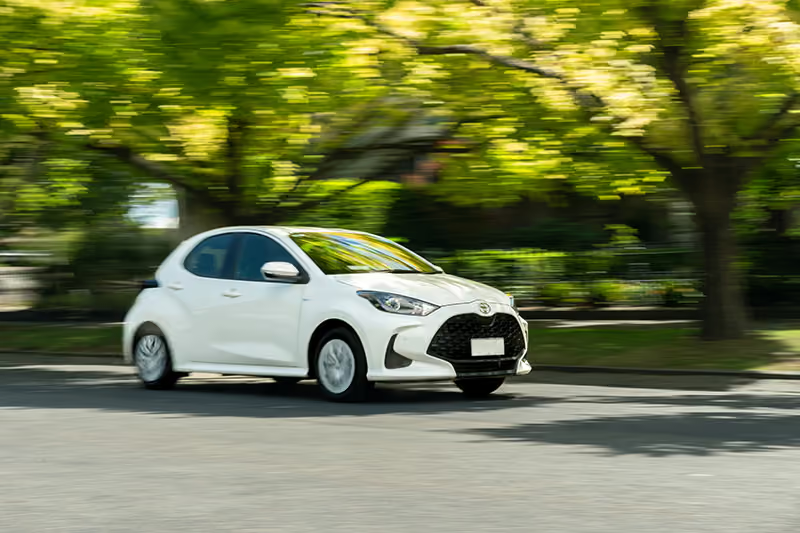
City driving is where you may notice how hybrid vs petrol cars compare. In stop-start traffic, petrol cars rely on their engine throughout the whole journey, whereas Hybrid Electric Vehicles can make greater use of electric power at lower speeds, creating a quieter driving experience that doesn’t compromise on performance. As traffic slows and starts again, the hybrid system switches between electric and petrol power and recovers energy during braking to recharge the battery.
Highway driving
Are hybrid cars good for highway driving?
Absolutely. Toyota Hybrid Electric Vehicles are designed for both city streets and highways. When cruising at high speeds, the petrol engine automatically supports acceleration[1], while the hybrid system assists as needed.
While fuel economy will vary between city and highway driving, the way you drive doesn’t need to change.
Which is more fuel-efficient: a hybrid or a petrol car?
Toyota Australia states that through intelligent switching, its Hybrid Electric Vehicles can offer improved fuel economy compared with equivalent petrol models, helping your fuel go further [1].
The Toyota RAV4 Hybrid is a great example. According to Toyota Australia, it has an official combined fuel consumption of 4.5L/100km[G43] for 2WD, and 4.6L/100km[G44] for AWD variants*[2]. While your actual fuel consumption may vary depending on factors like traffic, terrain, and other driving conditions, hybrids are designed to help you go longer between refuelling.
What is it really like to drive a hybrid car every day?
The first thing you might notice is how quiet the vehicle feels when it moves away. Beyond that, the features you may use every day, like the air conditioning, infotainment system and driver-assisted technologies, work just as they would in a traditional petrol car. There’s no need to select different driving modes or learn a new routine; the hybrid system manages the power automatically while you drive.
Picture the end of a busy workday. You collect your KINTO, pull out of the car park and head into peak-hour traffic. The drive feels quieter than you might expect as the hybrid system uses electric power at lower speeds. As you accelerate onto the highway, the petrol engine joins in automatically. Before long, everything feels second nature, and by the time you're almost home, the hybrid technology has faded into the background. You're simply enjoying the drive.
Is a hybrid worth it for everyday driving?
For many drivers, yes. Toyota Hybrid Electric Vehicles are designed to make everyday driving feel familiar while offering the benefits of hybrid technology, such as quieter low-speed driving and improved fuel economy compared with equivalent petrol models. If you spend a lot of time commuting, running errands or driving in stop-start traffic, a hybrid can be a practical choice.
Experience a hybrid for yourself
Reading about hybrid technology is one thing, but experiencing it and seeing how it might fit into your lifestyle can give you a better sense of whether it’s the right fit for you. A short test drive might not give you a clear picture of how a hybrid performs in everyday life, like in peak-hour traffic, on the highway or during your regular commute. With KINTO, you can hire a Toyota Hybrid Electric Vehicle and see how it suits your lifestyle before making your next vehicle decision.
Not sure which car suits you? Drive a Toyota hybrid with KINTO before you decide.
See the KINTO vehicle range and pricing.
FAQs
Are hybrid cars slower than petrol cars?
This is not necessarily the case. Toyota Hybrid Electric Vehicles use a combination of petrol engines and electric motors to deliver smooth, responsive acceleration. Because the electric motor provides full power in an instance from low speeds, drivers may find that hybrids perform more efficiently than petrol-only cars [1].
Are hybrid cars good for highway driving?
Yes. Toyota Hybrid Electric Vehicles are designed to perform in both city and highway driving. At higher speeds, the petrol engine does more of the work, while the hybrid system continues to assist in the background as needed. The driving experience remains familiar, making a hybrid just as suitable for longer road trips as everyday driving.
*Results were achieved under laboratory conditions and do not reflect the fuel economy in real world driving.
[G43] Results for RAV4 Cruiser CVT Hybrid Electric AWD in ADR81/02 combined drive cycle fuel consumption testing. Urban cycle results achieved 4.4L/100km & extra urban cycle achieved 4.8L/100km. Results were produced using new sample vehicles without fitment of accessories/customisation, & may not be replicable.
[G44] Results for RAV4 GX CVT Hybrid Electric 2WD in ADR81/02 combined drive cycle fuel consumption testing. Urban cycle results achieved 4.2L/100km & extra urban cycle achieved 4.7L/100km. Results were produced using new sample vehicles without fitment of accessories/customisation, & may not be replicable.
Sources
[1] Toyota Australia -Toyota Hybrid Electric Vehicles (HEVs)